
Light-carrying chips advance machine learning

Parallel convolutional processing using an integrated photonic tensor core
Image
bhaskaran nature

Machine learning and artificial intelligence applications make use of vast troves of data.  Our data is increasing exponentially and using this data to create information requires computer processing.  The capabilities of conventional computer processors are not sufficient to keep up with this demand.

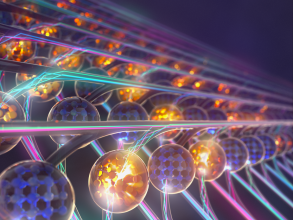
Members of Professor Harish Bhaskaran's Advanced Nanoscale Engineering Group, Johannes Feldman and Xuan Li, along with an international research team, have developed a new approach and processor architecture which provides a potential avanue to perform these tasks at high throughput - essentially by combining processing and data storage functionalities into a single chip - so called in-memory processors, but using light.

The team implemented a hardware accelerator for so-called matrix-vector multiplications.  Such operations form the backbone of neural networks (a series of algorithims which simulate the human brain) that are used to compute machine learning algorithims.  Using light allowed the team to use multiple wavelengths of light to do parallel calculations since light has the amazing property of having different colours that do not interfere.  However, to do this, they used yet another recent invention, a chip-based frequency comb, as a light source.  Once the chips were designed and fabricated, the researchers used a convolution neural network for the recognition of handwritten numbers.

The full paper can be read in Nature.

Placeholder

Light-carrying chips advance machine learning

A team of international scientists have demonstrated an initial prototype of a photonic processor
Placeholder

Nanoscale films of a pure metal exist in two stable optically distinguishable states

Oxford scientists have demonstrated for the first time that nanoscale films of a pure metal, Antimony (Sb), can exist in two optically distinguishable states at room temperature
professor simon hooker

Professor Simon Hooker awarded IOP Medal

Congratulations to Professor Simon Hooker who has been awarded the 2020 Cecilia Payne-Gaposchkin Medal and Prize
karen hampson

Senior Researcher Karen Hampson on Building Connections

Senior Research Karen Hampson is Chair Elect of the Applications of Visual Science OSA Technical Group
oxhighq3

Oxford Spin-out wins IOP Business Award

Oxford Spin-out HighQ (co-founders Professors Jason Smith and Claire Vallance) wins IOP Business Award
Madhavi Krishnan

Professor Madhavi Krishnan wins Royal Society of Chemistry Prize

Congratulations to Professor Madhavi Krishnan for winning the 2020 Royal Society of Chemistry Corday-Morgan Prize
the oxford trust awards 2019 075 2

Laser Writing Spin-out wins Start-up Award

Department of Engineering Science Spin-out Opsydia (co-founders Professor Martin Booth and Dr Patrick Salter) wins Oxford Tust Start-up award
johnstanford

Prestigious IET Award for DPhil student in Engineering

John Sandford O'Neill has been announced as the recipient of an Institution of Engineering and Technology (IET) Postgraduate Award
Ian Dobbie

Dr Ian Dobbie wins the RMS Vice-President's medal 2019

Dr Dobbie has made a unique and outstanding contribution to both running the Oxford-wide Micron imaging facility
diamond marking

Oxford Spin-Out Opsydia in the News

Oxford Engineering Spin-out Opsydia featured in the BBC Business article: How do you know your diamond isn't fake?
op icon

Oxford Photonics Day 2019

2019 Photonics Day - Wednesday 24th April
Donal Bradley CBE FRS

Professor Donal Bradley awarded the E-MRS 2019 Jan Czochralski award

The Award Presentation Ceremony will take place on September 18, 2019
Placeholder

Light-carrying chips advance machine learning

A team of international scientists have demonstrated an initial prototype of a photonic processor
Placeholder

Nanoscale films of a pure metal exist in two stable optically distinguishable states

Oxford scientists have demonstrated for the first time that nanoscale films of a pure metal, Antimony (Sb), can exist in two optically distinguishable states at room temperature
professor simon hooker

Professor Simon Hooker awarded IOP Medal

Congratulations to Professor Simon Hooker who has been awarded the 2020 Cecilia Payne-Gaposchkin Medal and Prize
karen hampson

Senior Researcher Karen Hampson on Building Connections

Senior Research Karen Hampson is Chair Elect of the Applications of Visual Science OSA Technical Group
oxhighq3

Oxford Spin-out wins IOP Business Award

Oxford Spin-out HighQ (co-founders Professors Jason Smith and Claire Vallance) wins IOP Business Award
Madhavi Krishnan

Professor Madhavi Krishnan wins Royal Society of Chemistry Prize

Congratulations to Professor Madhavi Krishnan for winning the 2020 Royal Society of Chemistry Corday-Morgan Prize
the oxford trust awards 2019 075 2

Laser Writing Spin-out wins Start-up Award

Department of Engineering Science Spin-out Opsydia (co-founders Professor Martin Booth and Dr Patrick Salter) wins Oxford Tust Start-up award
johnstanford

Prestigious IET Award for DPhil student in Engineering

John Sandford O'Neill has been announced as the recipient of an Institution of Engineering and Technology (IET) Postgraduate Award
Ian Dobbie

Dr Ian Dobbie wins the RMS Vice-President's medal 2019

Dr Dobbie has made a unique and outstanding contribution to both running the Oxford-wide Micron imaging facility
diamond marking

Oxford Spin-Out Opsydia in the News

Oxford Engineering Spin-out Opsydia featured in the BBC Business article: How do you know your diamond isn't fake?
op icon

Oxford Photonics Day 2019

2019 Photonics Day - Wednesday 24th April
Donal Bradley CBE FRS

Professor Donal Bradley awarded the E-MRS 2019 Jan Czochralski award

The Award Presentation Ceremony will take place on September 18, 2019